
People used to believe that teleportation was a notion that could only be found in science fiction. However, as the year 2040 draws closer, the possibility of teleportation being a reality is growing. A wide range of fields, including quantum physics, nanotechnology, and the flow of matter, are witnessing remarkable advancements thanks to the efforts of scientists and engineers from all around the world. As a result of these modifications, we are perilously close to using this brand-new technology. In twenty years, let us discuss the possible futures of teleportation, including those that are attainable, those that are wanted, and those that are possible (Barrow, 2022).
The Possible: Quantum Teleportation of Information
Despite the fact that it is still in its infancy, quantum teleportation has already been shown to be technically feasible through the transmission of quantum information over relatively short distances. By the year 2040, quantum computers will be faster, and quantum communication channels will be more robust. This would make it possible to send the most fundamental things as well as the most complicated knowledge across cities or even countries.

Source: https://newatlas.com/physics/three-dimensional-quantum-teleportation/
Figure 1. A 3D render visualizing the teleportation of quantum data particles across shimmering energy fields, with technological circuitry in the background.
Our current understanding of quantum entanglement and the no-cloning theorem provides the foundation for this possibility despite the fact that it comes as a complete surprise. According to Baum (2021), the mastery of large-scale quantum teleportation has the potential to revolutionize a variety of fields, including data transfer, cryptography, and even molecular manufacturing.
The Probable: Short-Range Matter Transmission
Given the current state of affairs, the most plausible possibilities for teleportation by the year 2040 are around deterministic transportation across very short distances. There is a high probability that near-future breakthroughs will concentrate on perfecting quantum teleportation by enhancing signal stability, fidelity, scalability, and range. These innovations will build upon ideas that have previously been established (Cohen, 2021).
Solid-state or atom-based systems are making quantum repeaters that create entanglement between distant stations a reality, expanding their operating range from meters to kilometers. Imagine complex chemical compounds, hydrogels reassembled from a transport stream, or even specific cell structures being transported intact across meticulously controlled environments—it’s all within reach.
The demonstration of quantum teleportation across short distances is set to accelerate commercial applications. “Molecular 3D printing” technology holds the potential to transform various industries by enabling the teleportation of customized molecules. One exciting application is the delivery of nanoscale therapeutic payloads directly into the body, eliminating the need for invasive surgeries.
A near-term goal is developing quantum memory capable of maintaining delicate quantum states, allowing for the redepositing of new information across long distances. This could lead to hybrid technology integrating classical and quantum properties. Trustworthy quantum networks might securely transmit encrypted cryptographic keys to neighboring “nodes,” brought into close contact by autonomous drones or robots.
To advance this paradigm, the principles of deterministic control systems from cybernetics are expected to be applied. By leveraging practical quantum technologies making steady progress, we can maintain momentum and eventually unlock revolutionary capabilities. The future is bright, and these incremental steps are guiding us toward a world of unprecedented possibilities.
Short-Range Matter Transmission Facility
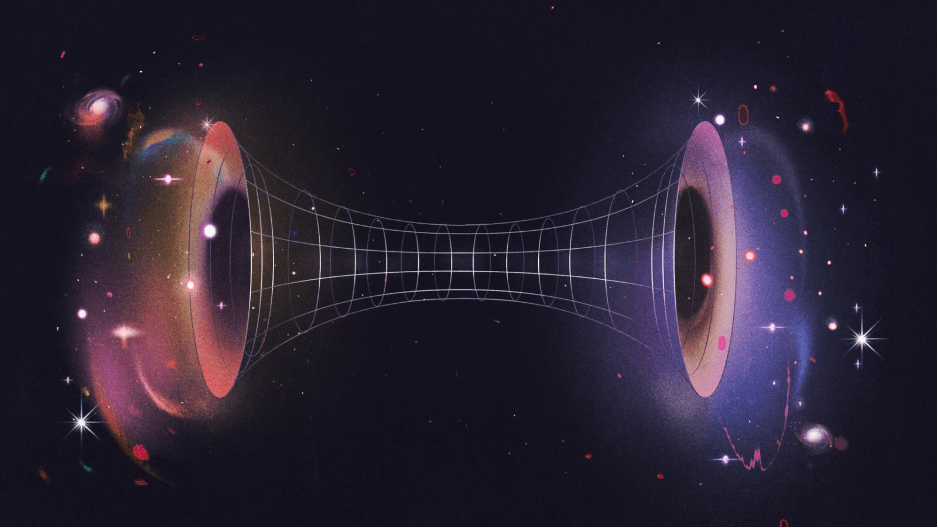
Source:https://www.quantamagazine.org/physicists-create-a-wormhole-using-a-quantum-computer-20221130/
Figure 2. A futuristic laboratory with holographic control panels, surrounded by energy fields and intricate machinery, seemingly designed for teleporting objects across the room.
The Preferable: Safe, Sustainable Human Teleportation
In spite of the fact that the simple teleportation of inanimate stuff or data would constitute a significant technological advancement, the most desirable scenario would entail the extension of this power to human beings in a manner that is secure, ethical, and environmentally sustainable. Nevertheless, this presents us with a plethora of issues that we need to examine from a philosophical, ethical, and practical standpoint (Dick, 2022).
Regarding the metaphysics of personal identity and the question of what constitutes a continuing self throughout disintegration and reintegration, we are required to tackle these issues from a philosophical perspective. In addition, there are critical ethical problems about permission, privacy, and prevention of the misuse of this technology.
In addition, to make human teleportation genuinely desirable, it must be a technique that is ecologically sustainable and energy efficient and adhere to a concept of a circular economy, as outlined by academics such as Darko Suvin. It is a monumental challenge, both scientifically and ethically, to safely rebuild a human being’s molecular structure without causing any harm to the original (Makridakis, 2022).
Notwithstanding, if we are effective in beating these deterrents, human instant transportation can possibly achieve a significant change in development. In a world without actual boundaries, people could travel huge spans very quickly. It would likewise work with space investigation and help settle clashes. Each new innovation that achieves an adjustment of the world requires cautious thought and the board of its perils, as well as progressing endeavors to guarantee the most potentially mindful and impartial organization.
By 2040, transportation might stop being a science fiction dream and start to happen in reality. We should gauge the ramifications of making a trip to a solid, super-durable human instant transportation future that does not discolor our ethical quality or otherworldly respectability. Acquiring capability in even short-range matter exchange would be critical, yet it requires cautious thought.
References:
Barrow, J. D. (2022). The Anthropic Cosmological Principle. Physics Today, 40(9), 84–86. https://doi.org/10.1063/1.2820190
Baum, S. D. (2021). Would contact with extraterrestrials benefit or harm humanity? A scenario analysis. Acta Astronautica, 68(11-12), 2114–2129. https://doi.org/10.1016/j.actaastro.2010.10.012
Cohen, J. (2021). What Does a Martian Look Like?: The Science of Extraterrestrial Life. In Google Books. Turner Publishing Company. https://books.google.com/books?hl=en&lr=&id=2nnuEAAAQBAJ&oi=fnd&pg=PT7&dq=First+Contact:+Scientific+Revelations+and+Ethical+%22Aliens:+The+World%27s+Leading+Scientists+on+the+Search+for+Extraterrestrial+Life&ots=Tf1ddy54sD&sig=xm1zYGrvRwnfVnNPy9fIdx7cca0
Dick, S. J. (2022). Analogy and the Societal Implications of Astrobiology. Astropolitics, 12(2-3), pp. 210–230. https://doi.org/10.1080/14777622.2014.964132
Makridakis, S. (2022). The forthcoming information revolution. Futures, 27(8), 799–821. https://doi.org/10.1016/0016-3287(95)00046-y
 To the Gong and Back