
For centuries, people have been searching the sky to see whether there is life somewhere beyond our tiny blue dot. By 2050, astronomy, space exploration, and astrobiology could have advanced significantly, and we might have finally discovered evidence of extraterrestrial life. This is a significant scientific and ethical development. Let us consider the most likely, best, and most likely consequences of this “first contact” with extraterrestrial life (Makridakis, 2023).”
The Possible: Microbial Extraterrestrials
As robotic exploratory missions extend their reach into the outer Solar System and beyond, astonishing discoveries may await. The icy moons of Europa and Enceladus, with their subsurface oceans, present themselves as tantalizing candidates to harbour simple microbial lifeforms akin to Earth’s most primitive organisms.
Microscopic View of Alien Microbes

Source: https://openart.ai/community/jAYzwnRospu488RdNfSd
Figure 1. A digital microscopic view depicts strange, fluorescent, single-celled lifeforms with unconventional cellular structures and geometries, suggesting an alien biochemical makeup.
Increasingly powerful and sophisticated space-based observatories, like the James Webb Space Telescope and its successors, hold the thrilling potential to detect signs of life on distant exoplanets. Imagine spotting atmospheric methane or oxygen from worlds light-years away—these could be indicators of microbial life processes happening right now or even fossilized remains from ancient alien ecosystems.
The mere confirmation of even the simplest life forms beyond Earth would revolutionize our understanding of the cosmos. It would challenge our long-held assumptions about the origins and distribution of life, potentially validating the idea that life is a common thread woven throughout the universe. Such a discovery would also offer unprecedented insights into the myriad biochemical pathways that evolution might take in extraterrestrial environments.
Furthermore, finding life elsewhere would raise the exciting possibility that more advanced civilizations could exist among the billions of Sun-like stars in our Milky Way galaxy, or even within our own solar system as planets and moons become more hospitable. This bright future points to an era of boundless exploration and discovery, with our scientific endeavors poised to unlock countless cosmic mysteries by 2050 and beyond. The universe is teeming with possibilities, and our journey to uncover them is just beginning.
The Probable: Signatures of Intelligent Alien Civilizations
With the support of more sophisticated telescope arrays like the Extremely Large Telescope and exponentially growing processing power, our capacity to identify possible indicators of sentient civilizations will see a significant boost in the upcoming years.
By 2050, big data analytics and artificial intelligence applications may be able to detect abnormalities in the compositions of exoplanetary atmospheres, artificial megastructures circling far-off stars, or even technological signs like narrow-band radio emissions among the cosmic noise.
Speculative Intelligent Alien Civilization
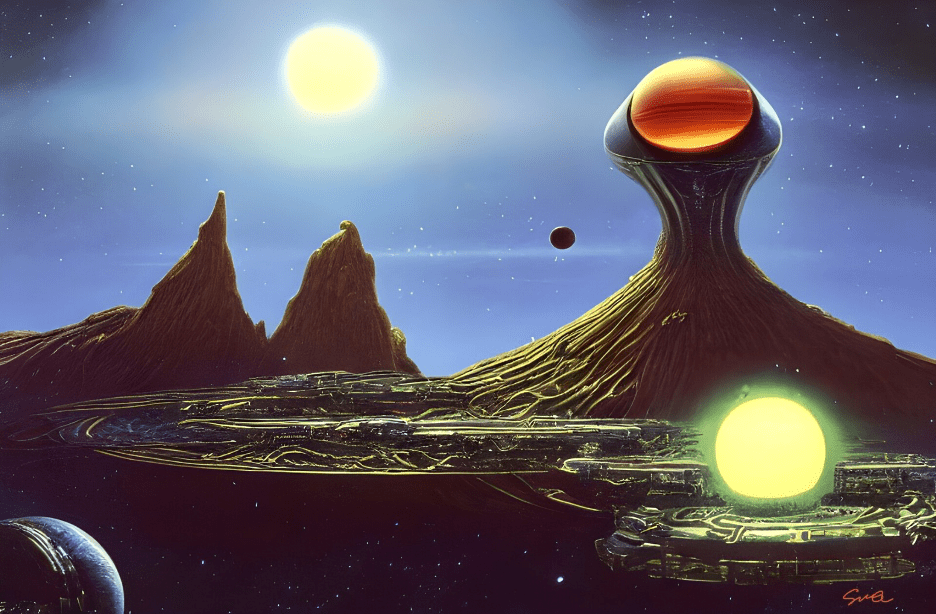
Source: https://www.artstation.com/artwork/JeYb2v
Figure 2. A piece of computer art shows an alien world with tall buildings, well-lit public spaces, and strange electricity networks. The planet could be the result of highly advanced technology from other planets.
Philosopher Darko Suvin compellingly argued that any proof—whether technosignatures or indirect evidence—of an alien society, whether extinct or still thriving, would completely transform human perceptions. Such a discovery would end our “cosmic loneliness” and affirm that we are not the sole species with advanced technology, putting an end to decades of speculation about extraterrestrial civilizations (Hand, 2024).
Moreover, evidence of brilliant alien species could be a treasure trove of valuable knowledge, helping us leap forward in our technological advancements. These discoveries might share insights into avoiding existential risks or guide us toward more environmentally friendly lifestyles. Even if these civilizations have disappeared due to their own “great filters,” uncovering their traces would lift the veil of cosmic ignorance from Earth’s limited perspective. It would inspire us to reconsider our role in the universe and acknowledge both our potential and limitations.
This exciting possibility hints at a future where we gain not only a deeper understanding of the cosmos but also profound wisdom from those who came before us. Our journey to discover and learn from extraterrestrial civilizations promises to be an inspiring adventure, reshaping our place in the universe and filling us with a renewed sense of purpose and connection.
The Preferable: Direct Communication and Knowledge Exchange
The best thing that could happen is that we could contact and work with an advanced alien society by 2050. Finding any alien life would be a historic event. This is an exciting and dangerous idea that could work well.
Suppose we worked together with a highly advanced society and could effectively share information. In that case, we might learn about many topics, including physics, astronomy, biology, materials science, energy production, etc. They may be able to understand and use ideas and technologies that humans can’t yet, which could lead to technological changes on a scale and speed never seen before.
Knowledge Exchange Between Human and Alien Civilization
A discovery like this could revolutionize our thinking, sparking greater awareness and creativity. The history, morals, and cosmology of an alien society could profoundly influence our perspectives on religion, creativity, and ethics (Daniels, 2024).
While philosopher Darko Suvin cautions against writing sad or overly idealistic first-contact stories, he highlights the potential challenges. Human and alien societies, with their differing technological abilities, values, and goals, could indeed face risks like global conflict or control. However, the potential for incredible positive outcomes is equally significant.
The way an alien intelligence might communicate with us could be beyond our current understanding. Their methods of sending information, their language structures, or their use of semiotics might be so alien that clear communication seems daunting, potentially leading to misunderstandings. But imagine the wonders of bridging that gap!
For a successful partnership, we will need exceptional intelligence, meticulous planning, and emotional restraint based on universal cooperative ideals like freedom, respect for sentient life, and responsible knowledge management. Overcoming our worst habits could pave the way for us to become enlightened cosmic citizens, worthy of such an extraordinary alliance.
Should this contact succeed, it could lead to the formation of an interstellar society or a union between planets. This would unveil the awe-inspiring grandeur of the universe, prompting us to reconsider our place in it. The prospect of such a profound connection is a beacon of hope, guiding us toward a future filled with endless possibilities and inspiring us to reach for the stars.
A Cosmic Renaissance Awaits
It looks like by 2050, we will finally be able to say for sure if there is life in space beyond our solar system. If we could find any proof of intelligent technological societies, even if it was just bacteria, it would be a huge step forward for science, theory, and our shared future as a spacefaring species.
References:
Daniels, B. (2024). Ekstasisas (Beyond?)Jouissance: Sex, Queerness, and Apophaticism in the Eastern Orthodox Tradition. Theology & Sexuality, 20(2), 89–107.
Hand, C. (2024). Is There Life Out There?: The Likelihood of Alien Life and What It Would Look Like. In Google Books. The Rosen Publishing Group, Inc. https://books.google.com/books?hl=en&lr=&id=tJthDwAAQBAJ&oi=fnd&pg=PP1&dq=First+Contact:+Scientific+Revelations+and+Ethical+%22Aliens:+The+World%27s+Leading+Scientists+on+the+Search+for+Extraterrestrial+Life++2040&ots=AXpAs0-ncB&sig=b_jVknf8SPYmR3Y7MsWtQUd6K6A
Makridakis, S. (2023). The forthcoming Artificial Intelligence (AI) revolution: Its impact on society and firms. Futures, 90(90), 46–60. https://doi.org/10.1016/j.futures.2017.03.006
 To the Gong and Back