
This semester for my BCM212 research topic, I am thinking of exploring what the key student motivators are when attending university. My goal for this topic is to acquire an in-depth understanding of what students’ motivations are when attending university and how these can effect the student experience. I intend to explore the universal questions on what students think about university and what often comes to mind when studying something you like with pressure, friends, partying and being socially active while also edging towards a successful career.
I decided to explore this particular topic because I am interested in reflecting back on my own experiences as an undergraduate and am excited by the prospect of hearing what my peers have to say about the same topic and how it effects their student experience. I also feel it is a universal concern that many university students face in regards to what career path they want to take, and the feelings of uncertainty and insecurity many university students experience in regards to this.
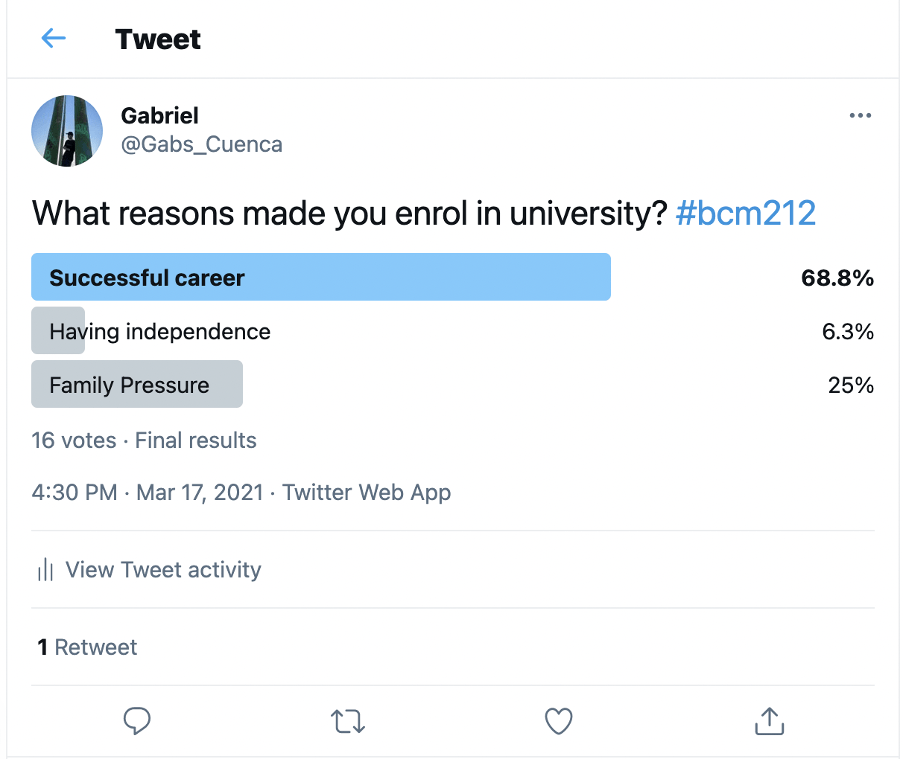
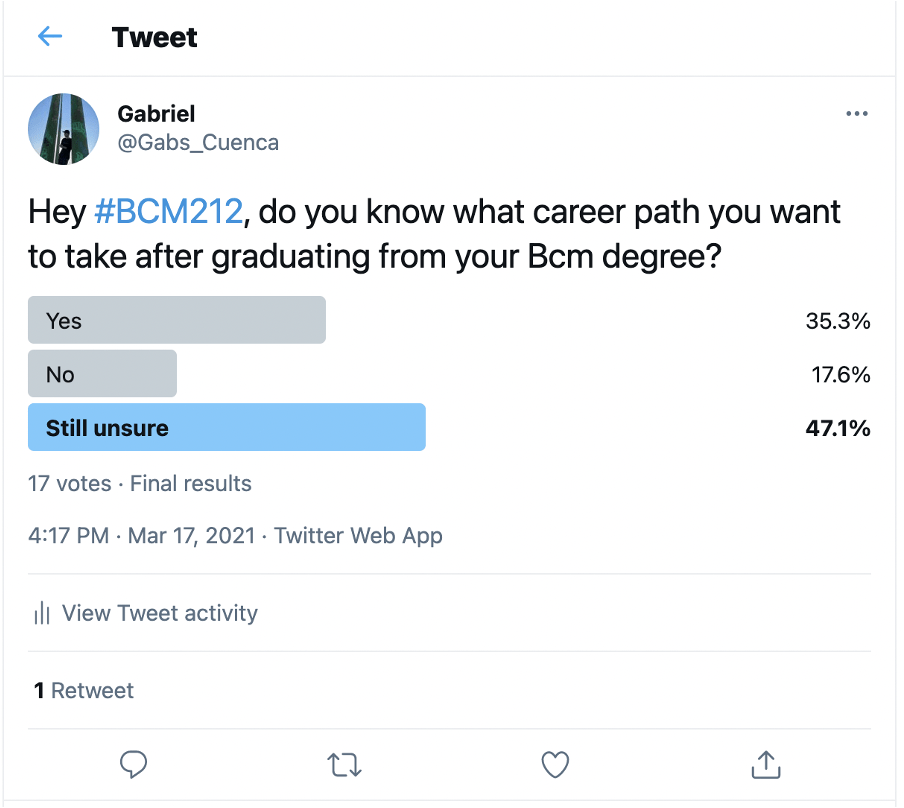
Appleton states that “the fear of making a misstep can often render us incapable of making decisions at all” (Appleton, 2016). This can be justified through the twitter pole results, 47.1% of the cohort are still unsure as to what they want to do after finishing Uni, and another 68.8% of people said that the main reason they attend university is to have a successful career after. These results particularly show to me that there is an issue to be explored in this space, posing the universal question, ‘What truly are the key student motivators when attending university?
Psychol states that the process of career decision making can be delayed “by the feelings of uncertainty and insecurity that the current economic and employment crisis is likely to arouse in young people” (Psychol, 2017). Upon further investigation and research when exploring this topic, this notion can already be partly seen where 68.8% of students said that the main reason they attended university is to achieve a successful career. Additionally, expanding on this point, Edgar states that when enrolling in university “self-belief was identified as the key dimension of motivation influencing student’s success” (Edgar, 2019). Both these points correlate well in the sense that, students will always face the pressure of striving for a successful career, which will bound to create insecurity and uncertainty when choosing a career path.
In relevance to this pitch and research topic, I personally feel that this subject affects many university students including myself, which can often result in people questioning why they are attending university and what their motivations truly are. According to Deci and Ryans Self-determination theory (1985), intrinsic motivation comes from within the individual, this can stem from setting individual goals or objectives for one to achieve and having the desire from within to achieve these. Most students have the desire to attend university based on their intrinsic motivation to “Strive to develop learning environments that are intrinsically rewarding” (Cherry, 2019).
Additionally, according to Deci and Ryan’s theory of motivation (1985), extrinsic motivation is another type of motivation and comes from external sources, “Extrinsic motivation is a construct that pertains whenever an activity is done in order to attain some separable outcome” (Deci and Ryans, 1985). For example, the rewards you may receive at university come from external sources, as you may push yourself to study to get a good grade, or feel it may be beneficial in the long-term for your career path.
This research topic to me is one that clearly needs further exploring and is something that interests me to a significant degree. It seems to be a universal concern among many students, not just at UOW, but around the world as to what are the key motivators for students are when attending university and how might these effect students experiences and desires both intrinsically and extrinsically. Through conducting analysis into the BCM cohort this semester, I seek to find out this universal question.
References:
Cherry, K (2019) Intrinsic Motivation. How your behaviour is driven by internal rewards. Cognitive Psychology. Accessed 20 March 2021
https://www.verywellmind.com/what-is-intrinsic-motivation-2795385
Deci, E.L. and Ryan, R.M. (1985) Cognitive evaluation theory. In Intrinsic motivation and self-determination in human behaviour (pp. 43-85). Springer, Boston, MA. Accessed: 15 March 2021
https://link.springer.com/chapter/10.1007/978-1-4899-2271-7_3
Edgar, S., Carr, S.E., Connaughton, J. et al (2019). Student motivation to learn: is self-belief the key to transition and first year performance in an undergraduate health professions program? BMC Med Educ 19,111. https://doi.org/10.1186/s12909-019-1539-5 (Accessed 20 March 2021)
https://bmcmededuc.biomedcentral.com/articles/10.1186/s12909-019-1539-5
Appleton, N (2016). The age of achievement: How the pressure to excel is striking the young. Collective. Accessed 20 March 2021 . https://collectivehub.com/2016/10/the-age-of-achievement-how-the-pressure-to-excel-is-striking-the-young/
 To the Gong and Back