
Who owns who?
A question that is of significant importance in reference to Australia’s media culture, but yet goes unnoticed by most of society. As we are consuming various different sources of information each day from media platforms such as tv, social media, newspapers and the internet, it is important to understand who owns and controls the media that we devour in our society and the influence this has on people and their perspective of the worlds current affairs. Whenever a news story breaks, or we are confronted with global issues such as the most recent coronavirus pandemic, people gain their information and insights from the media. Therefore, it’s easy to say that without any media sources we would be oblivious to these issues all together as it is the number one source people turn to for information. Jeff Cohen, founding director of the Park Centre for Independent Media, describes media as “The nervous system of a democracy; if it’s not functioning well, democracy can’t function”.
With this in mind, there is substantial pressure placed on current owners of Australia’s leading media platforms, to ensure the media provides diverse, trustworthy content to the rest of the population. So, who actually owns the media in Australia?
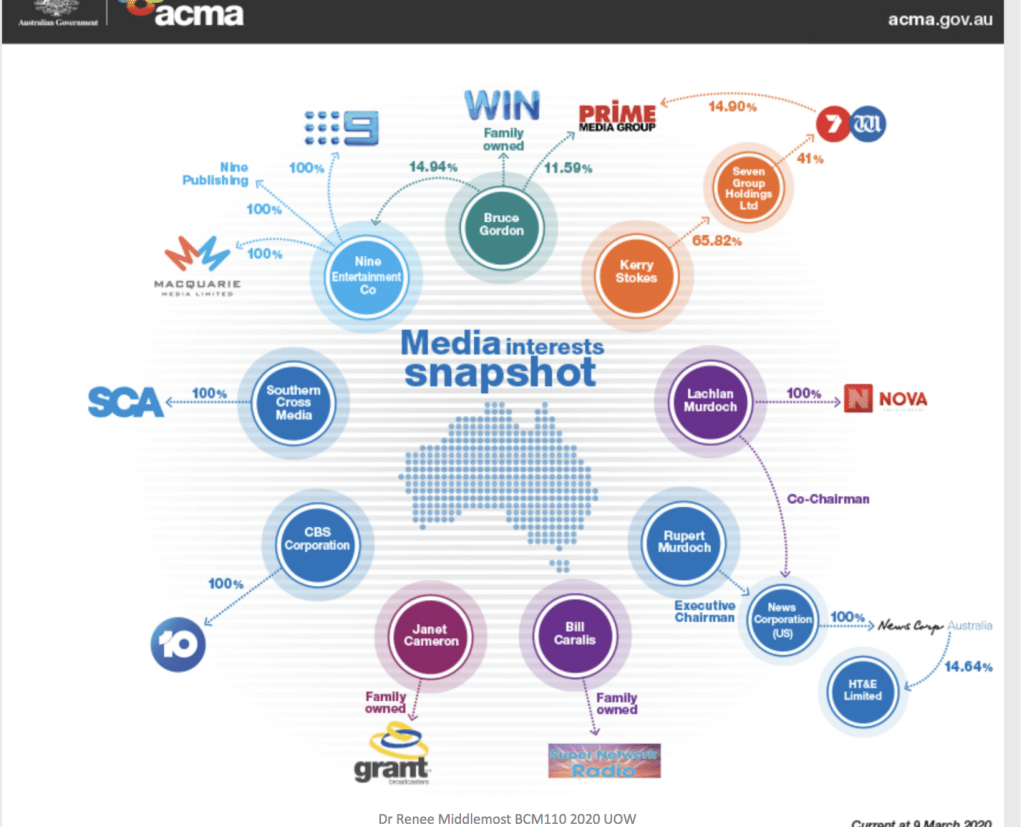
(https://www.acma.gov.au/sites/default/files/2020-03/Combined%20PDF.pdf)
The significance of these parties in providing reliable and diverse data in Australia’s media society is of fundamental importance in our contemporary world. Personally, the media I consume to gain my insights are predominantly engaged through social media platforms such as Twitter, Facebook or other online platforms. However, these are primarily based off pages in which I follow such as Channel Nine, which as highlighted above, is owned by Nine Entertainment Co. However, it also vitally important to consider how trustworthy these news sources actually are. In a study found by Australian market research company ‘Ipsos’ revealed that Australians place a 45% burden of fair trust when referring to online news outlets, this is compared to the rest of the world whom on average place little or no trust in online media sources.
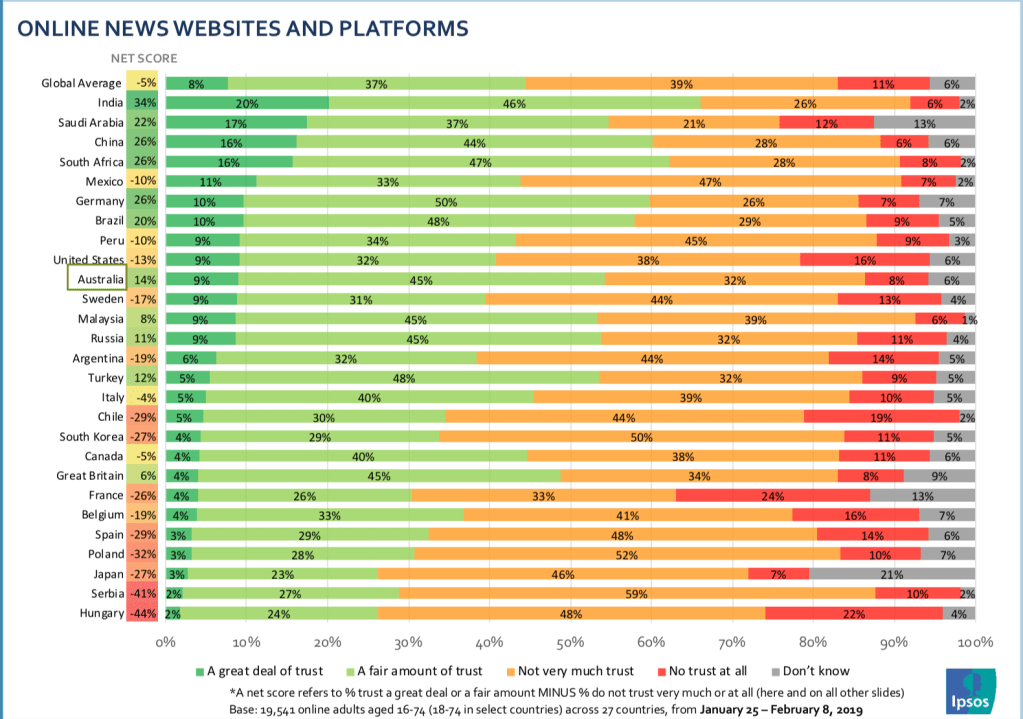
So that poses the question, ‘Who can you trust when referring to media ownership?’ and the truth is, there really isn’t a straight answer. There will always be bias viewpoints by certain media outlets, and often these are heavily influenced by who owns who, and what their respective ideologies may be, thus lending their portrayal of media more to their own perspective.
The whole conceptual notion of ideologies and how within a democracy there will always be contested viewpoints (i.e. Jeff Cohen’s point precisely), will ultimately always lead to conflict and potentially cause even more confusion. Unfortunately, there have already been cases where we’ve seen this happen. Most noteworthy through the horrific consequences of the Nazi regime. The way the Nazi party latched onto the idea of how people could be impacted by ideologies in the media, ultimately lead to Hitler’s reign in power. Thus, through Hitler’s control of the media, he was able to manipulate thoughts, beliefs and opinions within the minds of many.
Ultimately, we will always have conflicting questions on news stories and theories portrayed by certain media outlets. Unfortunately, there will always be a disadvantage in news sources and stories as they will be tailored to their own opinions and ideologies. Thus, as a result of this uncertainty within the media industry, it is truly up to the individual themselves to decipher the information on display and draw their own conclusions from the various sources out there.
References:
Ipsos. 2020. Australians trust the media less: Ipsos “Trust in the Media” study | Ipsos. Available at: https://www.ipsos.com/en-au/australians-trust-media-less-ipsos-trust-media-study. [Accessed 10 April 2020].
56 J. Broad. & Elec. Media 116 (2012) / Journal of Broadcasting and Electronic Media, Vol. 56, Issue 1 (March 2012), pp. 116-131 Available at: https://heinonline-org.ezproxy.uow.edu.au/HOL/Page handle=hein.journals/jbem56&div=11&collection=journals [Accessed 113 April 2020]
Media Interests snapshot and media interest maps—package | ACMA. 2020. Media Interests snapshot and media interest maps—package | ACMA. Available at: https://www.acma.gov.au/publications/2019-11/infographic/media-interests-snapshot-and-media-interest-maps-package. [Accessed 13 April 2020]
Compaine, B. M., & Gomery, D. (2000). Who owns the media? Competition and concentration in the mass media. Mahwah, NJ: Erlbaum [Accessed 10 April 2020]
 To the Gong and Back